
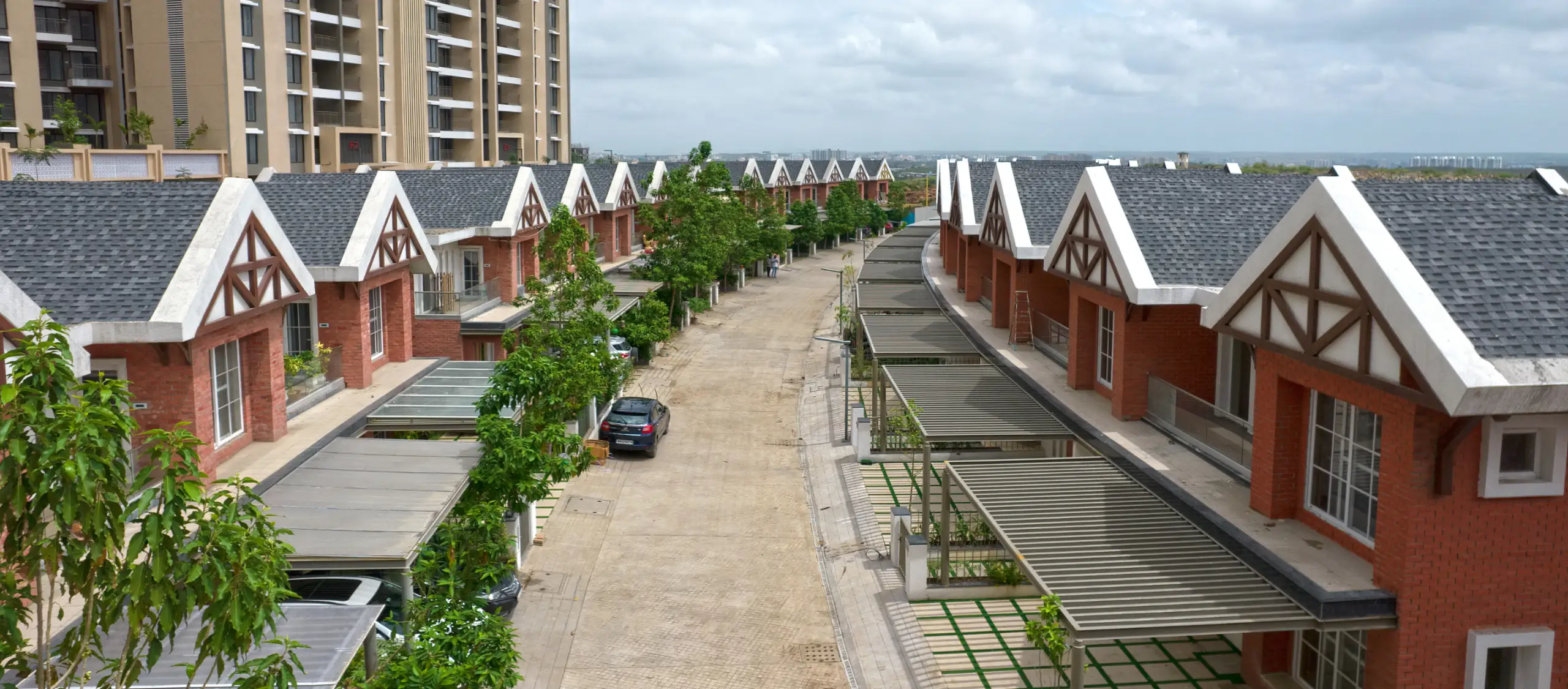
Charholi’s real estate story is not one of sudden discovery or overnight transformation. It is a story of gradual absorption into Pune’s expanding residential system. In 2026, Charholi is no longer positioned as an experimental suburb or a fringe alternative. Instead, it functions as a stable residential micro-market with its own daily rhythms, residential logic, and long-term relevance.
Understanding Charholi today requires separating perception from reality. Many buyers still evaluate it through outdated assumptions, while the on-ground reality reflects a location that has crossed multiple maturity thresholds.
From edge location to governed residential zone
Charholi’s early perception as a peripheral location was shaped by its rural past and low-density development. For years, it existed outside the mental map of most Pune homebuyers, largely because it lacked structured governance and consistent infrastructure.
The turning point came when planning norms, municipal oversight, and infrastructure upgrades began to align. Once an area enters structured urban administration, its development trajectory changes fundamentally. Growth becomes planned rather than reactive, civic services improve incrementally, and residential layouts begin to follow defined patterns instead of ad-hoc construction.
Charholi’s evolution follows this path. Its transition from a loosely defined edge zone to a governed residential area has laid the foundation for stability rather than volatility.
What residential maturity looks like
Residential maturity is often misunderstood. It does not mean full saturation or high density. Instead, it means predictability.
A mature residential micro-market typically demonstrates:
- Reliable access and internal connectivity
- Presence of essential social infrastructure
- Clear zoning between residential and mixed-use areas
- A growing base of end users rather than transient occupants
Charholi increasingly reflects these characteristics. Its growth has not been explosive, but it has been consistent, which is often a stronger indicator of long-term relevance.
What Lifestyle improvement actually means in Charholi today
Lifestyle improvement is rarely defined by landmarks or marketing narratives. It is defined by routines.
In Charholi today, Lifestyle improvement expresses itself through:
- Predictable daily movement rather than shortest-possible commutes
- Access to schools, clinics, and everyday retail without crossing the city
- Residential clusters designed for long-term use, not temporary occupancy
These factors reduce dependence on central Pune for routine needs, which is especially important for families and working professionals managing daily schedules.
The difference is subtle but meaningful. When everyday tasks feel manageable, residential satisfaction increases over time.
The shift from comparison to consideration
In earlier years, Charholi was often evaluated only in comparison with established city locations. Today, it is increasingly considered on its own merits.
Buyers entering Charholi in 2026 are rarely chasing novelty. Instead, they are intentionally looking for:
- Newer residential planning standards
- Lower congestion levels
- Better internal environments within housing clusters
Charholi fits into this preference set because it offers breathing space without isolation. It allows residents to live outside dense city cores without feeling disconnected from essential urban functions.
Congestion avoidance as a lifestyle choice
One of the strongest drivers behind Charholi’s residential acceptance is congestion avoidance. As central Pune areas become increasingly crowded, daily movement takes on greater importance.
Buyers are recognising that:
- Slightly longer distances with smoother movement can be preferable
- Predictable travel often matters more than proximity
- Reduced congestion improves overall quality of life
Charholi benefits from this shift in thinking, especially among families and long-term residents.
The stabilising effect of township-scale development
One of the defining aspects of Charholi’s residential landscape is the presence of large, planned residential ecosystems. Township-scale development plays a stabilising role that individual standalone projects cannot replicate.
Township-led development typically:
- Anchors infrastructure investment
- Accelerates the arrival of social amenities
- Creates internal demand ecosystems
- Encourages longer residential stays
This stabilisation effect distinguishes Charholi from fragmented suburban growth pockets where development is scattered and uneven.
Demand consistency versus demand spikes
Residential locations driven by speculation often experience sharp demand spikes followed by periods of stagnation. In contrast, Charholi’s demand pattern has been more consistent.
This consistency is supported by:
- A growing base of end users
- Family-led buying decisions
- Buyers with longer holding horizons
Such demand profiles usually lead to healthier residential environments and more predictable market behaviour.
How Charholi fits into North Pune’s growth logic
North Pune’s residential growth is not evenly distributed. Certain areas act as anchors that absorb population growth in a structured way. Charholi is increasingly playing this role.
Rather than functioning as a spillover zone, Charholi is evolving into a residential node that:
- Supports daily living independently
- Connects logically with employment corridors
- Absorbs growth without overwhelming existing infrastructure
This positioning strengthens its long-term relevance within the broader region.
The importance of internal environments
Beyond connectivity and location, buyers are paying closer attention to internal residential environments. Charholi’s newer developments often prioritise:
- Clear separation between traffic and living spaces
- Better light, ventilation, and open areas
- Shared amenities designed for regular use
These elements directly affect how homes feel over time, especially for families and older residents.
A gradual but meaningful perception shift
Charholi’s transformation has been gradual, which is precisely why it has been sustainable. Locations that change too quickly often struggle to integrate growth smoothly.
The perception shift around Charholi is now driven less by marketing and more by lived experience. Residents who move in for practical reasons often stay because daily life works.
Long-term residential suitability as the defining factor
For buyers planning to stay in a home for a decade or longer, suitability outweighs short-term convenience. Charholi’s appeal lies in its ability to support evolving life stages without forcing constant adjustment.
This long-term suitability is what separates stable residential micro-markets from temporary growth zones.
Charholi’s role going forward
As North Pune continues to mature, Charholi’s role is becoming clearer. It is no longer an alternative to the city, but an extension of it.
Its future is not defined by rapid transformation, but by steady integration. Infrastructure, occupancy, and social amenities are evolving together, which supports sustained residential relevance.
The bigger picture
Charholi’s emergence as a stable residential micro-market is not accidental. It is the result of planning alignment, demand quality, and Lifestyle improvement improvements moving in the same direction.
For buyers who value routine simplicity, planning clarity, and long-term comfort, Charholi increasingly represents a considered residential choice rather than a compromise.
